
10 Things Top Performers Do Better Than Others
By Dee Jones
What It Means to Be a Real Top Producer in Car Sales
In the United States, the average dealership salesperson is not selling 30 or 40 cars per month. Industry data from NADA shows that the average new-vehicle salesperson is closer to roughly nine vehicles per month, while the average used-vehicle salesperson is closer to roughly 11 vehicles per month. That context matters because it separates fantasy from reality. When someone is consistently selling 20, 30, or 40 vehicles per month, they are not operating at the normal pace of the average showroom salesperson. They are working at a different level entirely, and that level requires more than energy, charm, or one lucky run of strong floor traffic.
A 20-car salesperson is already performing above the normal rhythm of the business. A 30-car salesperson has usually built a real system around activity, follow-up, customer control, appointment setting, and repeatable process. A 40-car salesperson is doing something even bigger: they are not just selling cars inside the dealership; they are running a personal business inside the dealership. That type of production does not happen by accident. It requires math, discipline, follow-up, customer control, product knowledge, finance knowledge, and the ability to communicate with different types of buyers in different situations without losing confidence or structure.
A real top producer is not someone who has one big month and then disappears. Anyone can catch momentum once. A strong Saturday, a few easy deals, a few laydowns, and a couple of repeats can make a salesperson look better than they actually are for a short period of time. The real test is whether they can do it again next month, then again the month after that, and then again when the market tightens, traffic slows, inventory shifts, and customers become harder to close. Top performers are defined by repeatability. They do not just sell cars. They build a process that allows them to sell cars consistently.
The Math Behind 30–40 Units Per Month
A lot of people talk about wanting to sell 30 or 40 cars per month, but they never break down the math.
They want the result without understanding the activity.
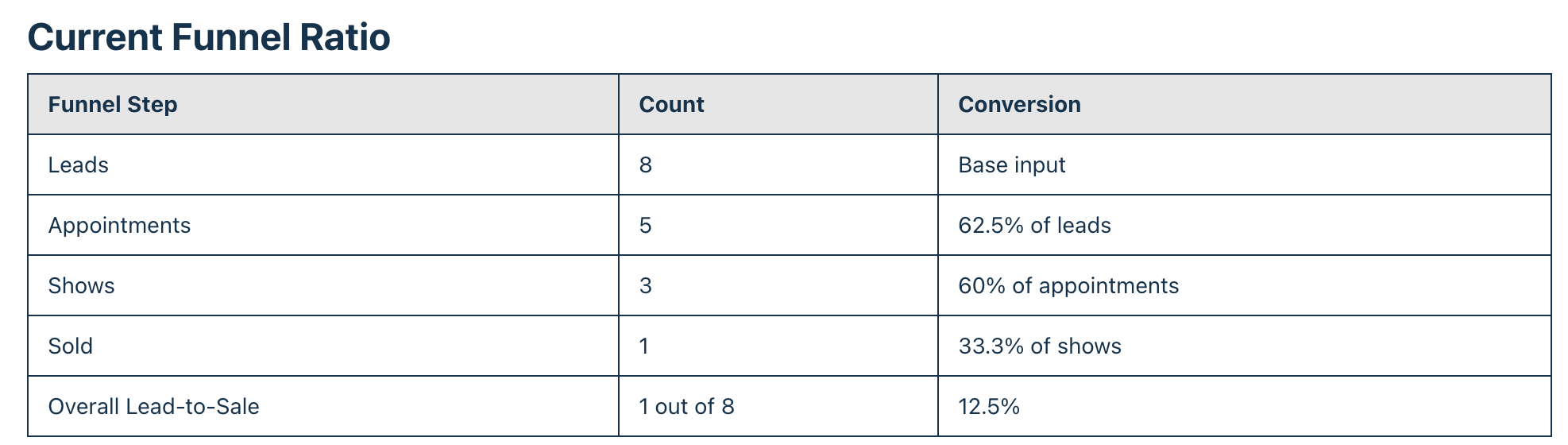
Here is a simple 30-day sales funnel based on the current conversion ratio:
8 Leads → 5 Appointments → 3 Shows → 1 Sold
That means every 8 leads should produce 1 sale if the process stays consistent.
Why Cox Automotive Data Matters
Cox Automotive’s Car Buyer Journey research reinforces what every serious salesperson already feels on the floor: the modern customer is doing more research before they ever complete a deal. Buyers are moving between third-party websites, dealership sites, search engines, social media, online retailers, reviews, payment calculators, trade-in tools, and now even AI-assisted shopping resources before they commit. By the time they contact a dealership or walk into the showroom, many customers have already formed opinions about the vehicle, the price, the dealership, the trade value, the payment range, and sometimes even the salesperson.
That means the modern top performer cannot be one-dimensional. It is no longer enough to be good only in person, only on the phone, only with fresh ups, or only with one type of buyer. A salesperson has to be visible online, strong in person, sharp on follow-up, comfortable with technology, and educated enough to guide a customer through a process that often starts long before the first handshake. The customer is researching everything: the car, the store, the reviews, the finance options, the salesperson’s credibility, and the competition. A weak or unprepared salesperson gets exposed quickly because the customer has access to more information than ever.
The modern buyer is not necessarily easier or harder than buyers from 20 years ago. They are simply different. They are more informed, more cautious, and more willing to keep shopping if the experience feels sloppy, unclear, or pressured. That is why the modern salesperson has to be more prepared. Product knowledge, finance knowledge, digital communication, follow-up discipline, and personal branding are no longer optional advantages. They are part of the minimum standard for anyone who wants to become a true top producer.
Top 10 Things Top Performers Do Better Than Others
1. Top Performers Repeat Wins
The first thing top performers do better than others is simple: they repeat wins. They do not live off one good month, one big paycheck, one strong weekend, or one lucky stretch of traffic. They understand that the board resets every month, and the dealership does not pay anyone forever based on what they did 30 days ago. Yesterday’s success may build confidence, but it does not deliver tomorrow’s units unless the process is repeated.
A lot of younger or newer salespeople make the mistake of thinking early success means they have the business figured out. They sell a few cars, get praised by management, make more money than expected, and start acting like the fundamentals no longer apply to them. That is usually when the business starts humbling them. The calls slow down. The follow-up gets loose. The urgency fades. The same habits that created the first wave of success disappear, and the salesperson starts wondering why the month feels different.
Top performers respect the repeat. They understand they have to make the calls again, set the appointments again, confirm the appointments again, ask the right questions again, follow up again, ask for the business again, and deliver a professional experience again. That is why true top producers are not built on motivation. Motivation comes and goes. Habits stay. The salesperson who can repeat the right habits when they are tired, busy, frustrated, or already ahead of the board is the one who eventually separates from the pack.
2. Top Performers Understand the Numbers
Average salespeople chase feelings. Top performers track numbers. That difference is massive. A salesperson who operates on feelings may say the month is slow, the leads are bad, the customers are not buying, or the market is dead. A top performer looks at the actual activity and asks a more useful question: how many real opportunities did I create, and where did the process break down?
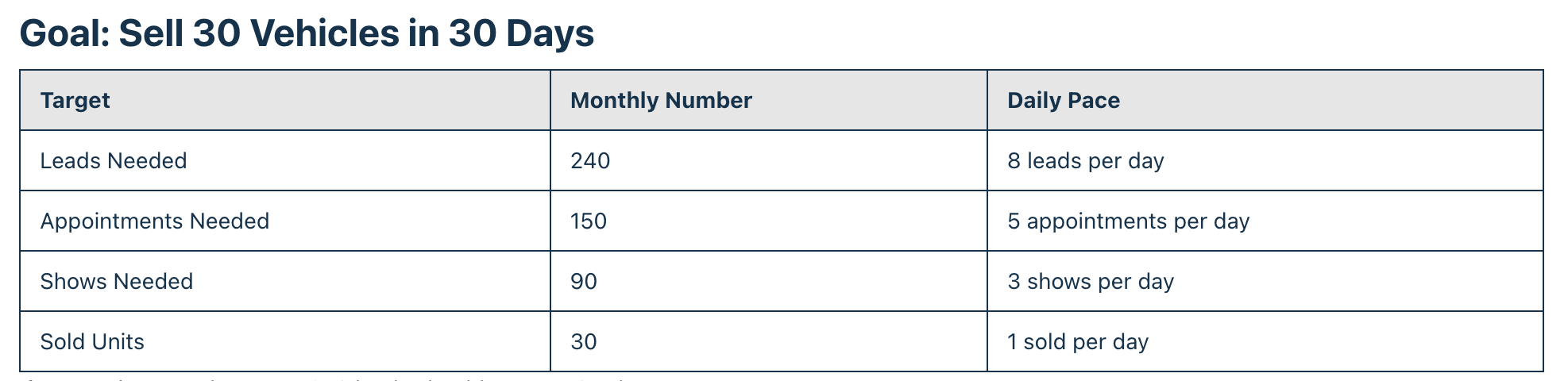
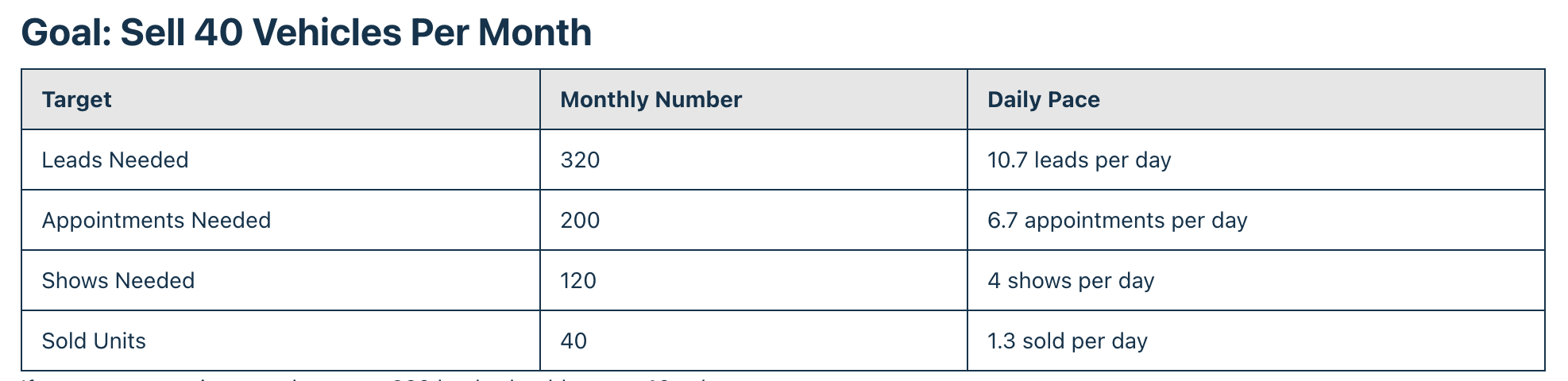
Top performers know how many leads they need, how many appointments they need, how many shows they need, and how many sales should come from that level of activity. If the goal is 30 cars and the store’s practical funnel is eight leads to one sale, then they understand they may need around 240 leads to reach that number. If the goal is 40 cars, they understand they may need around 320 leads. That does not mean every lead is equal, and it does not mean every month will fall perfectly into a formula, but it does give the salesperson a measurable standard instead of a vague hope.
This removes emotion from the process. Instead of saying, “It is slow,” the top performer asks, “Did I create enough conversations?” Instead of saying, “Nobody is buying,” they ask, “Did I follow up with enough people and move them to a next step?” Instead of saying, “The leads are bad,” they ask, “Am I converting at the level I should be converting?” Top performers do not guess their way through the month. They measure, adjust, and keep moving.
3. Top Performers Follow Up With Purpose
Most salespeople follow up once or twice and then quit. They leave a voicemail, send a text, maybe send one email, and then mentally move on when the customer does not respond. Top performers understand that follow-up is not a single action. It is a long-term conversation that requires timing, relevance, patience, and professionalism. A customer who says, “I’m just looking” today may buy in 30 days. A customer who gets declined today may come back next month with more money down. A customer who thinks the payment is too high may become ready when incentives change, inventory shifts, or their trade value improves.
The follow-up is where average salespeople lose deals they could have won. They interpret silence as rejection instead of recognizing that customers are busy, overwhelmed, comparing options, talking to family, waiting on money, or trying to make a responsible decision. A top performer does not take that personally. They stay professionally present. They send useful options, payment updates, walkaround videos, trade-in reminders, credit education, service records, warranty explanations, and helpful messages that move the customer closer to clarity.
Purposeful follow-up is not begging. It is not harassing. It is not sending “Are you still interested?” every three days until the customer blocks your number. Purposeful follow-up adds value. It gives the customer a reason to respond. It reminds them that the salesperson is still working for them, still thinking about their needs, and still capable of helping them make a better decision. Top performers understand that the money is in the pipeline, and the pipeline only pays when it is worked with intention.
4. Top Performers Are Well-Versed With Different Types Of Customers
Not being a well-versed salesperson will hurt you in the long run. If you can only communicate with one type of customer, you limit your income before the month even starts. The best salespeople can adjust to different ages, incomes, credit profiles, cultures, personalities, and buying motivations. They do not use the same word track on everyone because they understand that different customers need different kinds of guidance.
Some customers are analytical. They want numbers, rates, payments, comparisons, warranties, and details. Some customers are emotional. They want to feel comfortable, respected, and understood. Some are payment-driven and care more about the monthly obligation than the selling price. Some are credit-challenged and need patience, education, and a clear explanation of what the bank is looking for. Some are high-income buyers who do not want a long speech. They want efficiency, product knowledge, professionalism, and respect for their time.
The way you talk to a first-time buyer with thin credit should not be the same way you talk to a business owner buying a $90,000 truck. The first-time buyer may need help understanding proof of income, proof of residence, insurance, down payment, credit history, and what the bank needs to see. The business owner may want to discuss towing capacity, tax strategy, business use, depreciation, Section 179 possibilities, time savings, and how fast the deal can get done. Same dealership. Same salesperson. Completely different conversation.
That is versatility. A top producer can sell to the nurse, the contractor, the rideshare driver, the business owner, the retired couple, the recent college graduate, the bankruptcy customer, the luxury buyer, and the family that has not bought a vehicle in 10 years. The more types of customers you can serve well, the more dangerous you become in this business.
5. Top Performers Understand The Digital Showroom
The showroom is no longer only inside the dealership. Facebook is a showroom. Instagram is a showroom. Google reviews are a showroom. Your CRM is a showroom. Your text messages are a showroom. Your personal brand is a showroom. Today’s customer may meet you online long before they ever meet you in person, which means your digital presence is either helping you build trust or allowing someone else to win the attention first.
Top performers understand this. They post inventory, explain credit, answer common questions, show proof of success, highlight deliveries, build trust, and stay visible. They do not wait for the dealership’s marketing department to make them known. They take responsibility for their own visibility. They understand that attention creates opportunity, and opportunity creates conversations. A salesperson who is invisible online is depending almost entirely on the store to create their chances.
This is also why other salespeople start watching what a top producer does online. They see the posts, engagement, comments, leads, customer reactions, and inbound messages. Then they start copying. That is part of the game. But copying a post is not the same as building a brand. A real personal brand has consistency, credibility, knowledge, follow-up, and results behind it. Online visibility only works when the salesperson can back it up with real process once the customer responds.
6. Top Performers Ask Better Questions
Average salespeople talk too much. Top performers ask better questions. That one difference can change the entire deal. A weak salesperson tries to impress the customer with information before they fully understand the customer’s situation. A top performer slows down enough to discover what is actually driving the purchase.
They do not just ask, “What payment are you looking for?” They ask why the customer is shopping, what they are replacing, what changed in their life, who will be driving the vehicle, how long they plan to keep it, what they liked about their last vehicle, what they hated about it, and what would make the deal comfortable today. Those questions reveal the true shape of the deal. They uncover urgency, fear, budget, motivation, hesitation, and decision-making structure.
The best questions reveal what the customer is not saying directly. A customer may say they want a lower payment, but the real issue may be money down. A customer may say they need to think about it, but the real issue may be that they are not sold on the vehicle. A customer may say they need to talk to a spouse, but the real issue may be that they do not fully trust the numbers yet. Average salespeople respond only to the words. Top performers listen for the meaning behind the words.
7. Top Performers Know More Than Just How To Be Likable
Being likable helps, but likable alone is not enough. There are plenty of friendly salespeople who struggle because they cannot structure a deal, explain financing, handle objections, or guide customers through uncertainty. A top performer needs to understand the whole deal, not just the greeting and the test drive.
They need to know inventory, trim levels, leasing versus financing, rebates, incentives, trades, negative equity, credit tiers, bank approvals, vehicle suitability, and why a deal works or does not work. Customers can feel when a salesperson is guessing. They can also feel when a salesperson is educated. Knowledge creates authority, and authority creates calm. When a customer feels that the salesperson understands the process, they are more likely to relax and follow the guidance.
A top producer can explain why a customer with a low credit score and limited money down has limited options without making that customer feel embarrassed. A top producer can explain why payoff matters, why a lease payment differs from a finance payment, why the bank is asking for proof of income, or why more money down may change the structure of the deal. That kind of knowledge builds confidence. Confidence builds trust. Trust closes deals.
8. Top Performers Make Customers Feel Guided, Not Pressured
The old-school pressure approach is not enough anymore. Today’s customer has too many options, too much information, and too many ways to leave the process if it feels uncomfortable, confusing, or disrespectful. A customer who feels trapped can walk out, go home, continue shopping online, message three other stores, and restart the process without ever giving the first salesperson another chance.
Top performers do not make customers feel trapped. They make customers feel guided. They explain the process, set expectations, communicate what happens next, and keep the customer updated. They do not disappear for 25 minutes and leave the customer wondering what is happening. They do not bury people in dealership language. They simplify the process and make the customer feel like there is a plan.
A top producer understands that customers do not just buy the car. They buy the experience. They remember whether they felt respected, whether the numbers were explained clearly, whether the salesperson listened, and whether the process felt organized. That is why repeat customers and referrals matter so much. People may forget every detail of the transaction, but they remember how they felt while making the decision.
9. Top Performers Protect Their Attitude In A Competitive Office
The car business is competitive by nature. Salespeople are surrounded by other people who want the same leads, the same appointments, the same walk-ins, the same recognition, and the same money. The dealership is both a workplace and a scoreboard. Everybody can see who is working, who is winning, who is slipping, and who is making excuses.
When you are a top producer, people notice. Some people will cheer for you. Some will learn from you. Some will copy you. Some will quietly hope you slow down. That is why top performers have to protect their attitude. They cannot let the room control their energy. They cannot become bitter because people are watching, arrogant because people are copying, lazy because they are ahead, or distracted because dealership politics are loud.
Top performers learn to stay centered. They do not need to talk about their numbers all day. They let the results speak. They understand that emotional discipline is part of production. A bad attitude can cost appointments, weaken follow-up, ruin customer interactions, and turn one rough day into a rough week. Protecting your mindset is not motivational fluff. It is a business strategy.
10. Top Performers Build A Personal Brand That Follows Them
A dealership can give you inventory, a CRM, a desk, a phone, a website, and a place to work. But the best salespeople understand that their name has to mean something too. Your personal brand is what people say about you when you are not in the room. It is whether customers trust you, remember you, refer you, and know what you specialize in.
Do people know you can help with approvals, trades, leasing, financing, first-time buyers, business vehicles, credit situations, luxury units, specialty vehicles, or difficult deals? Do they know how to contact you? Do they see proof that you are active, knowledgeable, and consistent? A top performer does not rely only on the dealership’s advertising to create attention. They create their own attention and turn that attention into a book of business.
They collect reviews, stay visible, post value, educate customers, follow up after the sale, and make it easy for people to find them. That is how a salesperson becomes more than an employee. They become a resource. And once you become a resource, your value goes up. Customers are no longer just buying from the dealership. They are buying from you because your name carries trust.
Final Thought
The car business will always reward people who can sell, but it rewards the most those who can adapt, repeat, and stay consistent. The best salespeople are not always the loudest, the flashiest, or the ones talking the most in the tower. More often, they are the ones who keep showing up, keep learning, keep following up, keep adjusting, and keep repeating the wins long after the average salesperson has lost focus.
That is what top performers do better than others. They do not just sell cars. They build a process that sells cars consistently. They understand the math, respect the customer, study the deal, protect their attitude, work the pipeline, and develop a personal brand that creates opportunity beyond whatever traffic the store provides that day.
And when you understand the process, you do not have to be afraid to share information. Real winners are not competing with everybody in the room. They are improving the room. The people at the top are not threatened by other professionals getting better because they understand that stronger people create stronger cultures, better customer experiences, and more opportunity for everyone serious enough to do the work.
Competition is for losers. The people at the top are collaborating.

Check out:
rocketcarloan.com
columbuscarcredit.com
getpaidforyourcar.com
Call or text Dee directly at 740-956-0246, or connect with his partners at BizApp247, 888-919-1160, the leading AI-powered sales and marketing platform helping auto dealers and brokers across the Midwest build smarter, stronger, more connected businesses.
