Big Group vs. Small Store: A Salesperson and Manager Guide to Choosing Where You Work Wisely
By Dee Jones
Midwest Dealer Association
After 25 years in the car business, working inside four different new car franchises, big dealer groups, and smaller stores, I have learned one thing clearly there is no perfect dealership.
There are only different environments, different opportunities, different politics, and different trade-offs.
A salesperson or manager can make money at a big corporate group. A salesperson or manager can build a great life at a smaller dealership. But the mistake people make is choosing a store only based on the name on the building, the brand on the sign, or what somebody promised them during the interview.
The better question is this.
What are you trying to accomplish?
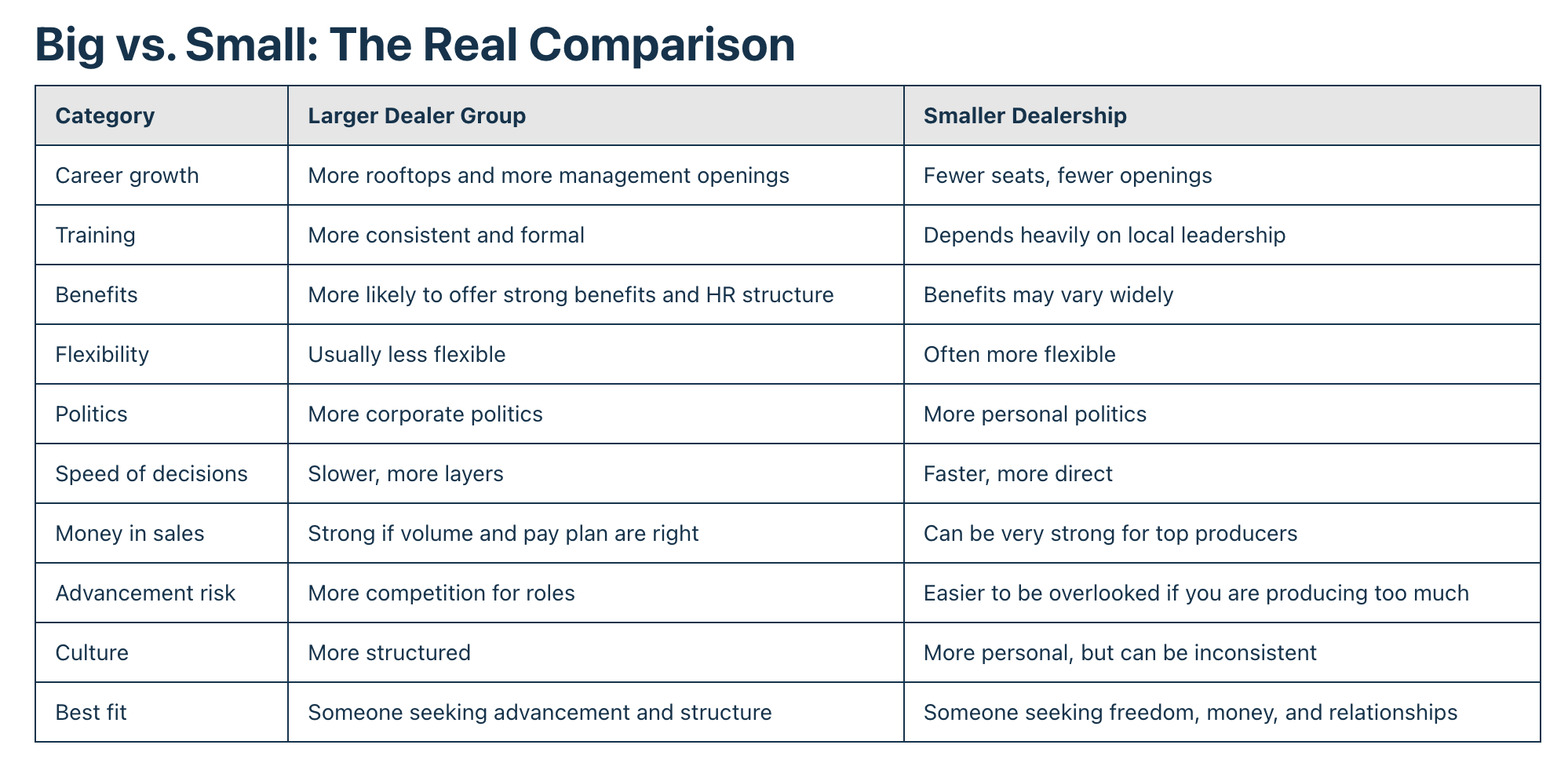
If you are trying to climb the corporate ladder, get into management, build a résumé, learn structure, and be exposed to multiple rooftops, then a larger dealer group may be the better fit.
If you are trying to make money, have flexibility, enjoy a more relaxed environment, build deep relationships, and operate with more freedom, then a smaller store may be the better fit.
Neither one is automatically better. But both come with advantages and disadvantages.
“A small store can give you freedom. A big group can give you a ladder. Neither one can give you happiness if the culture is wrong.”
The Big Dealership Group Advantage
Larger dealer groups usually have more structure. That can be good for a salesperson who wants training, consistency, leadership development, benefits, HR support, and a clear path to advancement.
The bigger the group, the more rooftops, departments, brands, and management seats exist. That matters. A growing organization creates movement. General managers move. Sales managers move. Finance managers move. New stores are acquired. People get promoted. Positions open up.
For someone trying to advance, that matters.
In larger groups, there is usually a stronger focus on process, compliance, corporate training, employee handbooks, onboarding, HR procedures, benefits, and performance tracking. That does not mean everything is fair. That does not mean politics disappear. But there is usually more documentation, more structure, and more formal accountability than you may find in a smaller independent-style environment.
Larger groups may also offer stronger benefits, including 401(k), health insurance, formal PTO policies, leadership training, and career-path conversations. For someone with a family, a long-term plan, or a goal of becoming a manager, those things matter.
The downside is that corporate life can feel restrictive. You may have less freedom in how you dress, how you market, how you prospect, how you communicate, and how quickly decisions get made. There may be more approvals, more meetings, more layers of management, and more policies. Sometimes the person making a decision about your future may not even work in your building every day.
That is the trade-off.
The Small Dealership Advantage
A smaller store can be a great place to make money.
If you are a high-volume salesperson at a smaller store, you may have more control over your day, stronger customer relationships, and more direct access to the decision-makers. You may be able to walk into the owner’s office, talk directly to the GM, or get an answer in five minutes instead of waiting for three departments to approve it.
Smaller stores can also be more flexible. The schedule may be more lenient. The dress code may be more relaxed. The culture may feel more personal. You may not feel like an employee number. You may feel like part of the store.
For some people, that is priceless.
But being a top producer at a small store can be a gift and a curse.
The gift is that you can make money. The curse is that the store may become dependent on your production. If you sell 25, 30, or 40 cars a month, ownership may love the gross, the volume, and the consistency. But when it is time to talk about management, you may hear.
“You have never managed anyone before.”
“We cannot replace you on the floor.”
“The next opportunity that comes along is yours.”
Then the next opportunity comes. And another one. And another one. And somehow your name is never seriously considered.
That is one of the hardest realities in the car business. A person can be valuable enough to keep in place, but not valued enough to elevate.
“Being irreplaceable on the floor can become the same thing that keeps you from getting promoted.”
The Industry Is Changing
The dealership business is still massive, but it is changing fast. Dealership groups are getting bigger. Consolidation is real. Larger organizations continue to buy stores, build regional platforms, and create more corporate-style automotive careers.
At the same time, smaller stores are not going away. Many smaller and family owned stores still have loyal customer bases, strong community relationships, and cultures that big groups cannot easily duplicate.
That is why this conversation matters.
When the business gets tougher, stores expose who they really are. When margins get tight, leadership matters. When traffic slows down, training matters. When interest rates, expenses, and affordability pressure customers, the quality of the people inside the store becomes the difference.
A dealership with bad leadership can break a good salesperson.
A dealership with no training can waste young talent.
A dealership with no advancement path can cause ambitious people to leave.
And a dealership with too much corporate politics can make talented people feel trapped.
The Politics Are Everywhere
Some people think going to a corporate store will help them avoid toxic people or bad managers.
It will not.
Toxic people exist in big groups and small stores. Bad managers exist in big groups and small stores. Favoritism, ego, insecurity, broken promises, and politics can show up anywhere people work together.
The difference is how much structure exists around the politics.
At a larger group, there may be HR, documented policies, performance reviews, and a chain of command. At a smaller store, things may be more personal. That can be good or bad depending on the people in charge.
Careers are made and broken by production, relationships, timing, reputation, and the ability to navigate people. If you cannot play the politics that come with working with others, the car business will be hard no matter where you work.
That does not mean you have to be fake. It means you have to be aware.
Know What Season You Are In
A young salesperson who needs training may need a big group.
A high-volume salesperson chasing income may need a smaller store with a strong pay plan.
A future sales manager may need a group that promotes from within.
A person burned out from corporate life may need a smaller store with more freedom.
A person stuck at a small store with no advancement path may need a bigger organization with more movement.
There is no right answer for everybody.
But there is a right answer for your season.
The Warning Signs
Before choosing a dealership, pay attention to what the store shows you before you even accept the job.
If they cannot explain the pay plan clearly, that is a warning sign.
If they cannot explain the advancement path clearly, that is a warning sign.
If every manager has been in the same seat for 10-plus years and nobody new has been promoted, that tells you something.
If they say, “We are like family,” but cannot explain benefits, training, schedule, process, or expectations, be careful.
If they hire anyone off the street without standards, be careful.
If they promise management but have no timeline, no plan, and no examples of people they have developed, be careful.
If they only value you when you are producing, but never invest in your growth, be careful.
“Do not confuse being needed with being developed.”
Final Word
The car business can change your life. It changed mine.
But you have to choose your environment wisely.
We spend more time at work than we do at home. We build our reputation there. We build our habits there. We learn how to win or how to survive there. The store you choose can sharpen you, pay you, promote you, frustrate you, or hold you back.
Big groups can give you structure, benefits, training, and a ladder.
Small stores can give you freedom, flexibility, relationships, and real money.
But no store is perfect.
The question is not simply big dealership versus small dealership.
The real question is:
Does this store match the life, income, reputation, and career you are trying to build?
Choose wisely.
Because in this business, the building you walk into every morning can either become a platform or a ceiling.

Check out:
rocketcarloan.com
columbuscarcredit.com
getpaidforyourcar.com
Call or text Dee directly at 740-956-0246, or connect with his partners at BizApp247, 888-919-1160, the leading AI-powered sales and marketing platform helping auto dealers and brokers across the Midwest build smarter, stronger, more connected businesses.
