
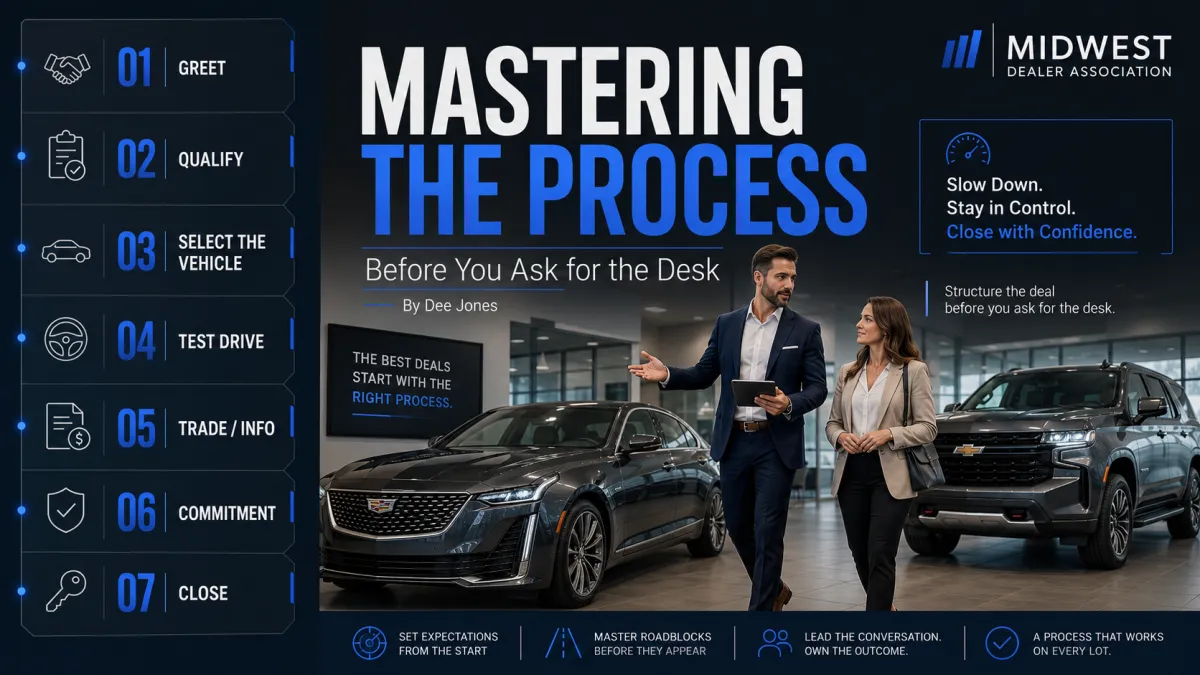
Master the Process Before You Ask for the Desk
By Dee Jones
A lot of salespeople want to be called “good” before they have mastered the basics.
They want manager access. They want to desk deals. They want to go to F&I. They want to be seen as leaders. But here is the truth: if you cannot walk a customer through the process without running back and forth to a manager every five minutes, you are not ready yet.
Being good in the car business is not just about personality. It is not just about being likable. It is not just about knowing inventory. Being good means you can slow the customer down, stay in control, identify the roadblocks, collect the right information, and move the deal forward step by step.
That applies whether you sell domestic, import, used cars, luxury, exotic, trucks, leases, cash deals, special finance, or commercial vehicles. The brand changes. The customer changes. The price point changes. But the process is still the process.
And the salesperson who masters the process can work anywhere.
A January 13 Cox Automotive Car Buyer Journey Study study found that 71% of all vehicle buyers were highly satisfied with the process, 76% of new-vehicle buyers were highly satisfied, and overall dealership process satisfaction rose to 76%. But the reasons for that improvement were not magic. Cox pointed to better selection, more efficient shopping processes, and smoother dealership experiences.
That is the word every salesperson should pay attention to: Efficient.
Efficiency does not mean rushing the customer. It means controlling the steps so the customer does not feel lost. It means setting expectations up front. It means knowing where the deal can break before it breaks. It means going into the manager’s office with a real deal, not a half conversation.
The Process Is What Gives You Control
A strong salesperson does not just “help someone look around.”
A strong salesperson leads.
That starts with the introduction. Then the needs assessment. Then selecting the right vehicle. Then the walkaround. Then the test drive. Then the trade conversation. Then the credit, cash, down payment, payoff, title, registration, and decision-maker information. Then the numbers. Then the commitment.
Before a salesperson walks into the manager’s office, they should already know the basics:
What vehicle does the customer want?
Why does that vehicle make sense?
Are they buying today if the numbers work?
Do they have a trade?
What is the payoff?
What is the real condition?
Who is on the title?
How much money are they putting down?
Are they financing, leasing, or paying cash?
Do they have credit concerns?
What payment range are they trying to accomplish?
Who else needs to be involved in the decision?
What objection is most likely to stop the deal?
If you do not know those answers, you are not ready to desk the deal.
You are guessing.
And guessing slows everything down.
Autotrader’s dealer guidance from the Cox Automotive Car Buyer Journey Study says dealers should lead with payment clarity early, audit friction and idle time, carry digital progress into the showroom, and prepare teams for informed buyers who expect clear answers in plain language. That lines up with what strong salespeople already know: customers do not want confusion. They want direction.
Slow Down to Speed Up
One of the biggest mistakes newer salespeople make is moving too fast.
They skip the introduction.
They skip qualifying questions.
They skip the trade conversation.
They skip the test drive.
They skip the trial close.
They skip the commitment.
Then they wonder why the customer disappears, objects to the numbers, or says, “I need to think about it.”
The problem is not always the price.
Sometimes the salesperson never built the case.
Slowing down keeps the deal under control. It allows you to find the objection before the customer uses it as a reason to leave. It gives you a chance to explain the process before the process feels uncomfortable.
Customers today are not uninformed. Cox found that 66% of buyers considered both new and used vehicles, and 71% went into the process with an open mind, unsure of exactly what vehicle they would buy. That means the salesperson has to be more than an order taker. You have to help interpret the information.
The customer may have looked online. They may know the price. They may know the payment calculator. They may have checked Carvana, CarMax, Kelley Blue Book, Autotrader, and three different dealer websites.
But they still need someone who can slow it down and say:
“Here is the vehicle that fits what you said you needed.”
“Here is why this structure makes sense.”
“Here is what the bank is going to look at.”
“Here is where the trade value comes from.”
“Here is what could stop the deal, and here is how we address it.”
That is sales.
The Objection Should Not Surprise You
Most objections are not random.
Payment.
Trade value.
Interest rate.
Down payment.
Credit.
Negative equity.
Vehicle selection.
Spouse or co-signer.
Time.
“I want to think about it.”
“I saw one cheaper.”
“I want to check with my bank.”
A professional salesperson already knows those objections are coming.
That is why setting intentions up front matters. You should be telling the customer what the process looks like before they are halfway through it.
A simple word track:
“Before we get too far, I want to make sure I understand what you are trying to accomplish. I’m going to ask you a few questions, find the right vehicle, make sure it fits your budget, look at your trade if you have one, and then we’ll go over real options. That way we are not wasting your time or guessing.”
That one statement gives the customer confidence because you sound like you have done this before.
J.D. Power’s 2025 U.S. Sales Satisfaction Index Study said the fundamentals of satisfaction have not changed: dealers who stay transparent, educate buyers on vehicle features, and maintain the relationship after delivery are the ones positioned to improve satisfaction and retention. (JD Power) That is exactly why the process matters. Transparency is not just what happens in F&I. It starts with the salesperson.
No Manager Tools Required
A salesperson does not need manager tools to be dangerous.
You do not need the desk screen to know if the customer is realistic.
You do not need trade software to ask the right trade questions.
You do not need F&I access to know if the customer has credit concerns.
You do not need the manager’s login to get a signed commitment to move forward based on the right vehicle, right structure, and right direction.
Before you walk into the manager’s office, you should have already built the deal in conversation.
The manager should not have to restart your process.
The manager should not have to re-ask every question.
The manager should not find out there is a trade after you already asked for numbers.
The manager should not find out the customer has no money down after you presented a payment that requires cash.
The manager should not find out the wife, husband, parent, business partner, or co-signer is not there after you spent two hours with the wrong decision-maker.
That is not a manager problem.
That is a process problem.
The Trade Conversation Is a Skill
Trade-ins are one of the biggest roadblocks in the deal. Customers are watching trade values online. They are checking multiple sources. They are comparing dealers to Carvana, CarMax, private party listings, and instant-offer tools.
TradePending’s 2025 survey of more than 1,000 vehicle owners found that 57% of shoppers check their trade value multiple times during the shopping process, and 56.5% ranked trade-in valuation as one of the most valuable features on a dealership website. (TradePending)
That means you cannot be casual with the trade conversation.
You need year, make, model, miles, payoff, title status, condition, accidents, ownership history, keys, tires, warning lights, and what number the customer has in mind. You may not appraise the car yourself, but you can prepare the customer for the appraisal.
A strong salesperson says:
“Just so I can give my manager the most accurate picture, tell me about the vehicle the way you would want someone to describe it if you were buying it.”
That question slows the customer down and helps you uncover the truth before the number becomes emotional.
F&I Starts Before F&I
The F&I office should not be the first time the customer hears about structure, protection, documents, or bank requirements.
CDK’s 2025 F&I Shopper Study reported that F&I remains a critical touchpoint in the buying journey, but wait times have increased and can risk customer goodwill. CDK also noted that time itself is not always the problem; how that time is spent matters. (cdkglobal.com)
That is why the salesperson has to prepare the customer before they get there.
If the customer is missing documents, tell them early.
If the bank may need proof of income, tell them early.
If the payment is tied to money down, tell them early.
If the approval is vehicle-specific, tell them early.
If the trade, payoff, or equity affects the deal, tell them early.
The cleaner the handoff, the faster the deal.
The faster the deal, the more confident the customer feels.
Practice Is How You Get Good
Nobody becomes good by accident.
You get good by practicing intros.
You get good by practicing phone scripts.
You get good by practicing service drive conversations.
You get good by practicing trade questions.
You get good by practicing payment objections.
You get good by practicing “I need to think about it.”
You get good by reviewing lost deals and asking where the process broke.
The next time a customer gives you an objection, you should not be hearing it for the first time. You should have practiced that response already.
A professional does not rise to the occasion. A professional falls back on training.
CDK’s Friction Points research said shoppers want more screen time and less wait time, while dealers are focused on improving the customer experience from devices to the showroom. But the study also pointed out that dealers still struggle with steps like negotiating price, securing financing, and even waiting on a test drive. (cdkglobal.com)
That is where trained salespeople separate themselves.
The process is not just a dealership checklist. It is how you protect the customer’s time, protect the manager’s time, and protect your own paycheck.
The Standard
Before I would consider someone ready for F&I, sales manager, desk manager, or any leadership role, I would want to see that person consistently walk a customer through the sale without needing constant rescue.
Can they greet?
Can they qualify?
Can they select the right vehicle?
Can they slow the customer down?
Can they test drive with purpose?
Can they ask for the trade information?
Can they find the decision-maker?
Can they ask for the business?
Can they get a commitment?
Can they identify the objection before the manager gets involved?
If the answer is no, they are not ready.
That may sound harsh, but it is true.
You cannot skip the steps and call yourself good.
The best salespeople are not always the loudest. They are not always the flashiest. They are not always the ones with the most manager access.
The best salespeople are the ones who can take a customer from confusion to confidence.
Step by step.
That is how you sell faster.
That is how you stay in control.
That is how you hit your target more times than not.
And that is how you become the kind of salesperson who can work anywhere.

Check out:
rocketcarloan.com
columbuscarcredit.com
getpaidforyourcar.com
Call or text Dee directly at 614-740-0246, or connect with his partners at BizApp247, the leading AI-powered sales and marketing platform helping dealers and brokers across the Midwest build smarter, stronger, more connected businesses.
