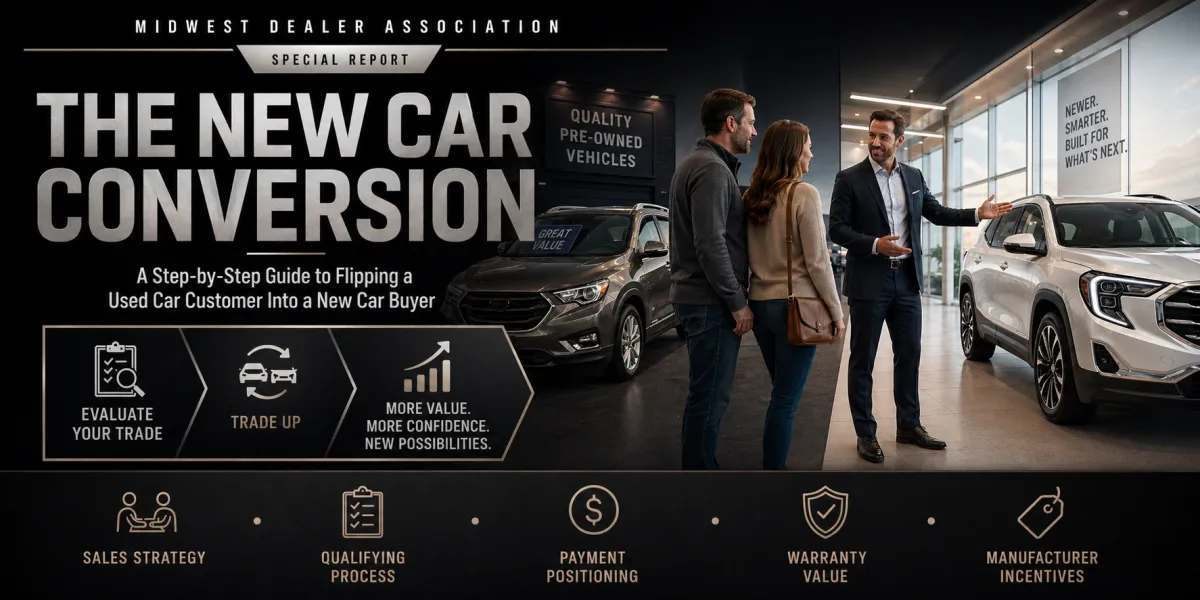
The New Car Conversion: How to Flip a Used-Car Customer Into a New-Car Buyer
By Dee Jones
If you are reading this, you want to do better. You are looking for ways to move the needle, create more opportunity, and separate yourself from the average salesperson. One of the biggest ways I was able to do that was by learning how to consistently flip used-car customers into new-car customers.
For a long time, I was traditionally a used-car guy. Like a lot of salespeople, I assumed that if the customer came in asking about used, that was the lane they belonged in. But working inside a Buick GMC franchise changed the way I looked at the process. Over time, I realized many of the customers I was advertising to were emotional buyers first and used-car buyers second. They were excited to be there. They wanted a win. They wanted a better experience. And many of them had never seriously considered that they could actually buy a brand-new vehicle from a nice franchise store.
That is where the opportunity lives.
Today’s buyer is far more flexible than many salespeople think. In an April 9 article, Cars.com reported that 53% of shoppers are looking for a new vehicle, 39% say finding a vehicle within budget is a major frustration, and 59% of new-car shoppers would consider used if new models are out of budget. That tells you something important: many buyers are not locked into “new” or “used.” They are trying to solve a payment problem, a transportation problem, and a life problem.
That matters even more in a market where affordable used inventory is still tight. In an April 17 article, Cox Automotive reported that used-vehicle days’ supply had fallen to 37 days, the lowest level in years, with average listing prices at $25,390. For used vehicles priced under $15,000, supply was just 27 days. In other words, the lower-price used units many customers think they want are often the hardest units to find and the hardest units to make sense on.
At the same time, new vehicles often come with advantages many customers do not expect. In an April 25 article, Experian reported that for fair-credit buyers, average APRs were 9.59% on new vehicles versus 14.46% on used vehicles. More broadly, in an August 15 article, Experian’s 2025 financing data showed average rates of 6.80% on new versus 11.54% on used. On top of that, in an April 23 article, J.D. Power projected average incentive spending of $3,141 per new vehicle in April 2026. That combination of lower rates and stronger factory support is exactly why a used-car customer should often be shown a new-car option.
The Process: How to Flip the Customer
Step 1: Start with the Customer, Not the Car
The first mistake a lot of salespeople make is taking the customer too literally. If the lead says “used SUV,” they run straight to the used inventory and never do any real discovery. I train my people to slow down and ask qualifying questions early.
• What are you driving now?
• How many miles are on it?
• What is your current payment?
• How long have you been on the job?
• What is your income source?
• Is there a trade?
• Is there a co-buyer?
• Is there a cosigner option if needed?
This is where deals are won. The best salespeople do not just gather information. They gather leverage.
Step 2: Know the Profile that Gives You a Chance
For marginal-credit customers, some patterns show up over and over again. Two years of consistent job time helps. Around $3,000 a month from a verifiable source is a strong benchmark in many deals, even if it is not an absolute rule. There are also real opportunities for self-employed customers, but they usually need cleaner paperwork and a more complete story.
The point is not to disqualify people. The point is to understand early whether a new-car approval might actually be the better approval.
A lot of salespeople assume the used unit is the safer play. Many times, it is not.
Step 3: Follow the Process Mechanically
Meet, greet, qualify, then land on a vehicle. The sales process is mechanical. The salesperson who skips steps usually loses control of the deal.
If the customer is driving something like a 2022 Buick Encore or a 2019 Equinox, I am almost always going to show them a new option too. Why? Because that comparison is where the flip happens.
I do not believe in guessing. I believe in showing.
Step 4: Present the 'Take-Away Car'
This is one of the biggest secrets. I like to show the customer the used option they expected, and then I show them the new option I believe gives them a better overall outcome. We call that the “take-away car.”
It is not a bait and switch. It is a comparison strategy.
The used vehicle gives them something familiar. The new vehicle gives them something aspirational. Now they are no longer deciding whether they can buy a car. They are deciding which car makes more sense.
That is a much better conversation.
Step 5: Sell the Payment Gap, Not Just the Price Gap
Used-car shoppers are usually trained to think in terms of sale price. Professionals learn to move the conversation to cost of ownership and monthly reality.
Yes, the new vehicle may carry a higher sticker. But if the rate is better, the incentive support is stronger, the warranty is longer, and the maintenance benefits are better, the payment gap is often smaller than the customer expected. Experian’s data shows exactly why that happens: used-car financing generally costs more than new-car financing, and fair-credit buyers especially tend to see a meaningful difference between new and used APRs.
This is where you earn your money.
Do not just say, “This one is newer.”
Say, “This one may actually be smarter.”
Step 6: Use Emotion the Right Way
Car buying is emotional. A lot of customers walk into a franchise store already assuming they do not belong there. They think the nice showroom is for somebody else.
If your customer does not think they can buy a new vehicle from a polished franchise store, use that feeling to close them.
Not with pressure. With possibility.
Show them what winning looks like. Show them the upgraded experience. Show them the better warranty, the cleaner history, the lower risk, the free oil changes if available, and the fact that they may leave in something they did not think they could get.
A great salesperson sells belief before they sell metal.
Step 7: Make the Manufacturer Money Visible
One reason this strategy works in today’s market is that factory money can do a lot of heavy lifting. Incentives, promotional APRs, lease support, loyalty programs, and other OEM-backed offers can make a new unit much more competitive than the customer expects. J.D. Power’s forecast showed incentive spending climbing to an average of $3,141 per vehicle, with incentives reaching 6.1% of MSRP.
If the customer never sees the factory advantage, they will keep comparing your new car to a used car with outdated logic.
Step 8: Negative Equity Can Help Create the Flip
Another reason the new-car flip works is because many customers are trying to get out of negative equity in their current vehicle. A lot of salespeople automatically assume negative equity means the customer has to stay in used, but that is not always true.
In many cases, a new vehicle can actually be the better solution because manufacturer incentives, promotional rates, and dealer cash can help absorb some of that negative equity while keeping the payment more manageable than the customer expected. J.D. Power projected that 31.3% of trade-ins would carry negative equity, while manufacturers were increasing incentive support to help offset that pressure.
If the customer is buried in their trade and wants out, showing them a new-car option can create a cleaner path than trying to fit all that negative equity into another used vehicle at a higher rate. That is especially true when the customer is trying to escape an older high-mileage vehicle, an unreliable car, or a loan structure that no longer makes sense.
Not every customer with negative equity can be flipped into a new car. If the negative equity is too deep, the income is too weak, or the structure still does not make sense, then the best move may still be a used or certified option. The key is knowing the difference.
Experts do not assume. Experts structure.
Step 9: Give the Customer a Choice, Not a Speech
I like to put the deal in front of the customer as a real side-by-side decision.
• Here is your used option.
• Here is your brand-new option.
• Here is the difference in payment.
• Here is the difference in warranty.
• Here is the difference in miles.
• Here is the difference in long-term peace of mind.
Now ask the right question:
Which one makes more sense for you and your future?
That closes better than pressure ever will.
Why this Strategy Works
This strategy works because it matches the way people actually buy today.
Buyers are frustrated on budget.
Affordable used inventory is still tight.
Many customers are payment shoppers, not category shoppers.
Factory money can make new more attractive than people assume.
And the salesperson who knows how to compare the two with confidence becomes more valuable than the salesperson who just walks the lot. Cars.com’s shopper data, Cox Automotive’s used-inventory report, and current Experian/J.D. Power financing and incentive data all point in that same direction.
The old mindset says, “They came for used, so sell them used.”
The better mindset says, “They came for a solution. Show them the best one.”
Final Word
This is one of the ways I was able to consistently sell around 20 new vehicles a month. I stopped assuming the customer’s first request was their final answer. I started qualifying harder, presenting better, and comparing smarter.
The salespeople who win in today’s market are not just good at finding a car. They are good at changing the customer’s belief about what is possible.
And once you can do that, you stop being just a used-car guy or a new-car guy.
You become the expert.

Dee Jones is an automotive sales leader, mentor, and industry contributor focused on developing high-performing professionals in retail automotive.
Check out rocketcarloan.com
columbuscarcredit.com
Call or text Dee directly at 614-740-0246, or connect with his partners at BizApp247, the leading AI-powered sales and marketing platform helping dealers and brokers across the Midwest build smarter, stronger, more connected businesses.
