
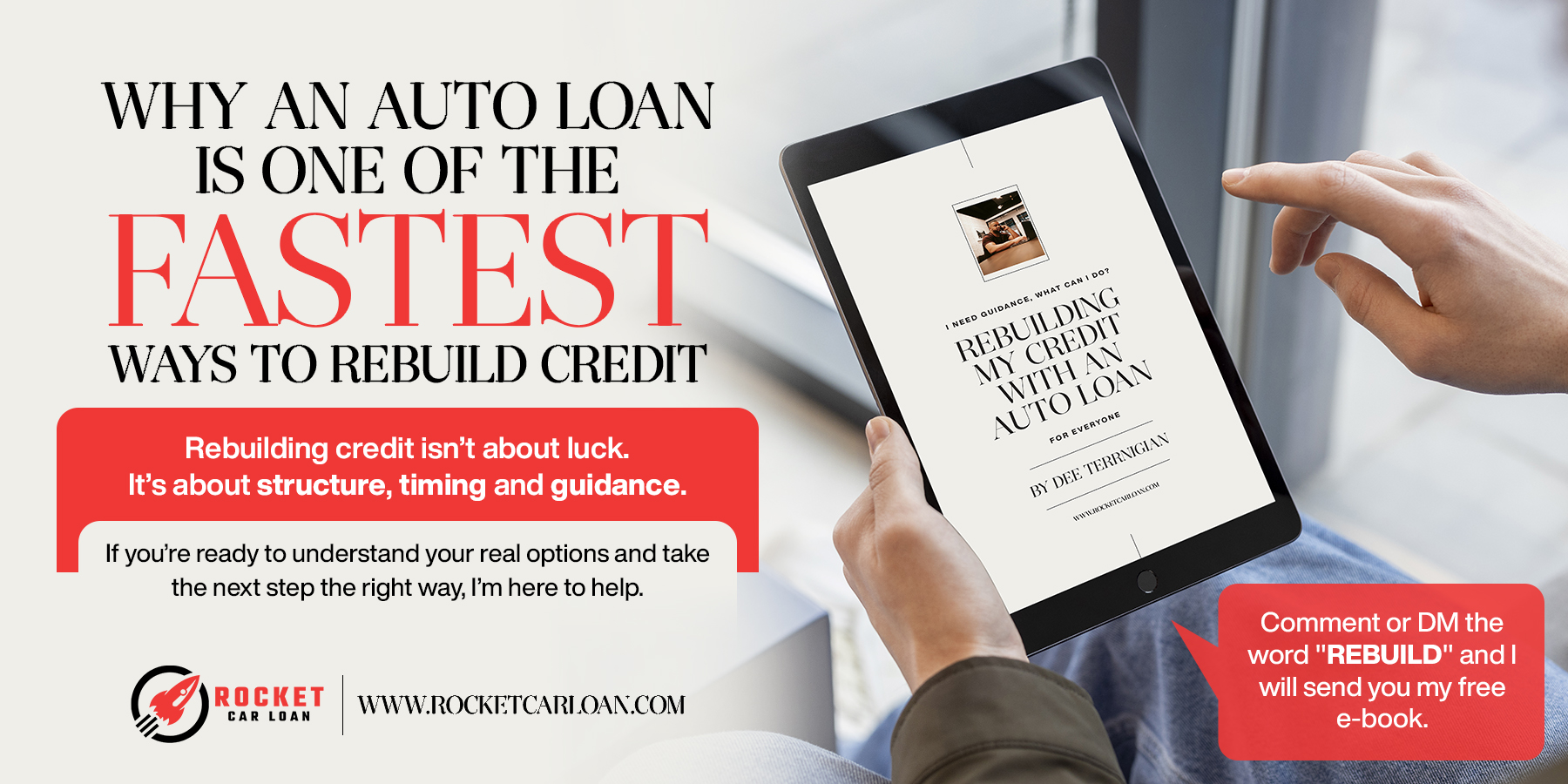
Why an Auto Loan Is One of the FASTEST Ways to Rebuild Credit
CHAPTER 1
Auto loans are different from credit cards
Here’s why lenders like them:
Fixed monthly payment
Fixed term (36–84 months)
Clear history of on-time payments
Easier to track responsibility
A properly structured auto loan can:
Build positive payment history
Improve your credit mix
Increase lender confidence
Open doors to better rates later
👉 One strong auto loan often does more for credit than multiple credit cards.
Auto loans rebuild credit quickly because they function as a structured, predictable “credit training program” that lenders can easily measure, unlike revolving credit cards where balances and utilization fluctuate month to month.
With an installment loan, the payment is fixed, the timeline is defined (often 36–84 months), and each on-time payment posts as a clear, repeatable signal of reliability—exactly what underwriters and scoring models want to see when they’re deciding whether you’ve turned a corner.
When the loan is properly structured (right vehicle, right payment, right term, and no overreach), it can stack months of positive payment history fast, strengthen your credit mix by adding an installment tradeline alongside revolving accounts, and demonstrate real-world responsibility under a larger obligation than a typical card payment.
Over time, that combination can increase lender confidence, reduce the “risk” label attached to your file, and make it easier to qualify for better approvals and lower rates on future financing—because you’re no longer just managing credit, you’re proving consistent repayment behavior on a major asset.
That’s why one strong auto loan, paid on time, often moves the needle more meaningfully than juggling multiple credit cards that can unintentionally hurt you if balances creep up or utilization spikes.
CHAPTER 2
Bad Credit vs Thin Credit (Most People Get This Wrong)
Not all low scores are the same.
Bad Credit
Late payments
Charge-offs
Repos
Collections
Thin Credit
Few accounts
Short history
Limited auto experience
Important truth:
👉 Thin credit often approves faster than damaged credit, even with a similar score.
Understanding which one you have changes the strategy completely.
Most people assume a low score automatically means “bad credit,” but lenders look deeper than the number, and the difference between damaged credit and thin credit can completely change your approval path.
Bad credit usually signals proven risk—late payments, charge-offs, repossessions, and collections tell a story of broken repayment patterns, which makes lenders price the loan higher, demand stronger proof of stability, require a larger down payment, or decline the deal outright because the file shows prior defaults.
Thin credit, on the other hand, often reflects a lack of data rather than a history of problems—maybe you only have a couple accounts, your credit history is short, you haven’t had an auto loan before, or your profile hasn’t matured long enough to demonstrate repayment consistency, even though you haven’t necessarily mismanaged credit.
That’s why thin credit can approve faster than damaged credit even when the score looks similar: the lender may see a “blank slate” with fewer negative indicators and more opportunity to structure a manageable first-time auto loan, especially when income, time on job, residence stability, and down payment support the file.
Once you correctly identify whether you’re thin or damaged, the strategy changes—thin credit is often about adding the right kind of tradeline and proving stability, while bad credit is about rebuilding trust, addressing derogatory items, and structuring payments that reduce risk—so diagnosing the category first can be the difference between a quick approval and a frustrating cycle of declines.
CHAPTER 3
What Lenders ACTUALLY Look At (Hint: It’s Not Just Your Score)
Credit score is only one piece of the puzzle.
Banks focus on:
Income stability (W2 preferred)
Payment-to-income ratio
Time on job
Auto loan history
Vehicle risk (year & miles)
This is why:
Someone with a 580 score can get approved
Someone with a 650 score can still get denied
👉 Structure matters more than score.
Most borrowers get hung up on the three-digit score, but lenders underwrite the whole story of whether the loan is likely to perform, and that story is built on stability, structure, and risk—not just a credit snapshot.
Banks and finance companies lean heavily on income reliability (with W2 income often viewed as more predictable than inconsistent self-employment), how your proposed car payment fits into your monthly obligations (payment-to-income ratio), how long you’ve held your job, and whether you’ve successfully handled an auto loan before, because prior auto performance is one of the cleanest indicators of future auto performance.
They also evaluate the collateral itself: older, high-mileage vehicles are considered higher risk because repairs, breakdowns, and maintenance shocks increase the odds of missed payments, so the year and miles can change the approval outcome even if everything else is equal.
That’s why a person with a 580 score can still get approved if the deal is structured intelligently—reasonable payment, stable income, acceptable vehicle, and manageable term—while someone with a 650 can get denied if the lender sees instability, overextended ratios, weak job history, or a vehicle that doesn’t fit the bank’s guidelines.
In the real world, structure matters more than score because lenders aren’t just approving people—they’re approving specific deals, and the deal has to make sense on paper.
CHAPTER 4
Why the WRONG Auto Loan Can Hurt Your Credit
Not all car loans help you rebuild.
A poorly structured deal can:
Stretch your budget
Increase risk of late payments
Trap you in negative equity
Slow credit improvement
Common mistakes:
Chasing the lowest payment only
Buying too old or too high mileage
Rolling too much negative equity
Applying everywhere at once
👉 Rebuilding credit is about sustainability, not just approval.
The wrong auto loan doesn’t just fail to help—it can actively set your credit back by creating a payment and vehicle situation that isn’t sustainable long enough to generate consistent, positive history.
A poorly structured deal often stretches your budget so tightly that one unexpected expense—repairs, insurance increases, medical bills, or a temporary income dip—pushes you into late payments, and late payments are one of the fastest ways to damage a score and weaken future lender confidence.
It can also trap you in negative equity when the loan balance stays higher than the vehicle’s value for too long, especially if you roll in too much from a prior loan; that makes it harder to refinance, harder to trade, and harder to “reset” into a better rate later, which slows the very credit progress you’re trying to create.
Many people unintentionally sabotage themselves by chasing the lowest payment without considering total cost and term length, buying a vehicle that’s too old or too high mileage (which increases mechanical risk and surprise costs), or applying everywhere at once—creating multiple hard inquiries that can signal desperation and reduce approval odds.
The real objective in rebuilding credit isn’t simply getting approved today; it’s choosing a deal you can comfortably pay on time every month for long enough to prove stability, build trust with lenders, and position yourself for better terms down the road—because sustainability, not approval, is what actually changes your credit trajectory.
CHAPTER 5
Choosing the RIGHT Vehicle When Rebuilding
Lenders prefer:
Newer model years
Reasonable mileage
Reliable brands
Vehicles that fit income level
Why?
Lower risk
Better resale value
Easier approvals
👉This doesn’t mean luxury is impossible—but it does mean strategy matters.
When you’re rebuilding credit, the vehicle you choose is part of the approval decision because lenders aren’t just evaluating you—they’re evaluating the risk of the collateral and how likely the loan is to stay healthy over time.
Newer model years with reasonable mileage typically mean fewer surprise repairs, less downtime, and a lower chance that an unexpected mechanical issue blows up your budget and triggers missed payments. Lenders also favor reliable brands and models because predictable ownership costs and stronger long-term durability reduce default risk, and vehicles with better resale value protect the bank if the loan ever has to be liquidated—so the deal is viewed as safer from day one.
Just as important, the vehicle has to fit your income level: if the payment and insurance consume too much of your monthly cash flow, the loan becomes fragile, which makes an underwriter hesitant even if the score is improving.
Choosing the “right” vehicle, then, is really about building a stable foundation—something that aligns with lender guidelines, holds value, and supports consistent on-time payments—because that’s what leads to easier approvals and faster credit momentum.
And while this doesn’t mean luxury is off the table, it does mean the path is strategic: the right structure, the right term, the right down payment, and the right unit can make a higher-end vehicle possible without turning your rebuild into a setback.
CHAPTER 6
The Truth About Down Payments
Down payment is NOT a magic number.
Sometimes:
Rebates replace cash
Structure matters more than money
A small down payment works fine
A large down payment doesn’t fix bad structure
👉 The right question isn’t “How much down do I need?”
It’s “What structure gives me the best long-term outcome?”
The down payment matters, but not in the simplistic way most buyers assume—because it isn’t a magic number that automatically guarantees an approval or a “good deal.”
In many real-world approvals, the strength of the structure is what carries the outcome: rebates or incentives can sometimes reduce the amount financed in a way that functions like cash, and the lender’s comfort level is often driven more by whether the payment fits your income, the vehicle fits the bank’s guidelines, and the term is reasonable than by a single dollar figure at signing.
That’s why a smaller down payment can work perfectly well when the deal is built responsibly—stable income, manageable payment-to-income ratio, a vehicle with acceptable year and mileage, and a term that doesn’t stretch you thin—while a large down payment can still lead to trouble if the structure is flawed, such as rolling heavy negative equity, choosing a high-mileage unit that’s likely to create repair shocks, or locking into a payment that forces you to live on the edge every month.
The goal isn’t to “buy” an approval with cash; it’s to build a loan that you can comfortably pay on time for long enough to create real credit momentum and position yourself for better rates later. That’s why the right question isn’t “How much down do I need?”—it’s “What structure gives me the best long-term outcome?”
CHAPTER 7
One Application vs Five (Why Fewer Is Better)
Every credit pull tells a story.
Multiple random applications can:
Lower your score
Signal desperation
Hurt lender confidence
One clean, properly placed pre-qualification:
Protects your credit
Gives accurate options
Creates smoother approvals
👉 Smart buyers apply once, not everywhere.
Every credit inquiry is a signal to lenders, and when you scatter applications across multiple dealerships or banks, the file can start telling the wrong story—one of urgency, uncertainty, or financial stress—even if that’s not what you intended.
Multiple random applications can shave points off your score through repeated hard pulls, but the bigger issue is how the pattern looks to an underwriter: a cluster of inquiries in a short window can suggest you’ve already been turned down, that you’re shopping for anyone who will say yes, or that you may be overextending yourself, which can hurt lender confidence and tighten the terms you’re offered.
In contrast, one clean, properly placed pre-qualification—done strategically with the right lender match for your profile—can protect your credit by limiting unnecessary pulls, produce more accurate options because the deal is structured around real guidelines (income, ratios, auto history, vehicle parameters), and create a smoother approval path with fewer last-minute surprises.
The smartest approach isn’t “apply everywhere and hope”—it’s to diagnose the credit file, choose the right structure, and submit one high-quality application that’s positioned to win, because smart buyers apply once, not everywhere.
CHAPTER 8
Bankruptcy, First-Time Buyers & Rebuilders
If you’ve had:
Chapter 7
Chapter 13
No prior auto loans
Good news:
👉 Many buyers qualify sooner than expected.
What matters most:
Time since filing
Income stability
Proper vehicle selection
Correct lender placement
👉Waiting blindly is often worse than planning intentionally.
For buyers coming out of bankruptcy, purchasing their first vehicle, or rebuilding after a rough credit stretch, the biggest misconception is that you have to “wait it out” with no plan—when in reality, many people can qualify sooner than they expect if the deal is positioned correctly.
Whether you’ve filed Chapter 7, are in or completing Chapter 13, or simply have no prior auto loan history, lenders tend to focus less on the label and more on the specifics of the file: how much time has passed since filing (or how consistent payments have been in an active Chapter 13), whether your income is stable and documentable, and whether the proposed payment fits comfortably within your monthly obligations.
From there, vehicle selection becomes a major lever—newer, reasonable-mileage, lender-friendly units reduce collateral risk—and “lender placement” is often the make-or-break factor, because the right lender for a bankruptcy or first-time file is not the same lender you’d use for a prime buyer.
When those pieces are aligned—timing, stability, vehicle, and lender match—approvals become less mysterious and far more predictable, which is why waiting blindly is often worse than planning intentionally: a smart, structured approach can turn “I’ll never get approved” into a realistic path that builds confidence, builds payment history, and positions you for better terms down the road.
CHAPTER 9
What Happens AFTER You Buy (This Is Where Credit Is Won)
Your credit rebuild doesn’t end at delivery—it starts there.
Best habits:
Pay on time (every time)
Avoid new credit for 3–6 months
Keep balances low
Stay consistent
Within 6–12 months, many buyers can:
Refinance
Upgrade vehicles
Lower payments
Improve interest rates
The real credit transformation doesn’t happen when you drive off the lot—it happens in the months that follow, because lenders and scoring models reward consistency, not intentions.
Once the loan is active, every on-time payment becomes a fresh signal that you’re reliable, which is why paying on time every time is non-negotiable; even a single late mark can erase months of progress and make refinancing or future approvals harder.
Just as important is what you don’t do: taking on new credit immediately after buying can raise your risk profile, add inquiries, and stretch your budget, so giving yourself a 3–6 month window to stabilize is often the smartest move.
Keeping credit card balances low during this period helps protect your overall profile by avoiding utilization spikes that can drag scores down, and staying consistent—same payment routine, same budgeting discipline, same financial behavior—creates a clean performance history that lenders trust.
When you stack those habits, the payoff can come quickly: within 6–12 months many buyers are in a stronger position to refinance into a better rate, reduce their payment, upgrade to a newer vehicle with more favorable terms, and see meaningful interest-rate improvement—because at that point you’re no longer “rebuilding” in theory, you’re proving it in real time.
CHAPTER 10
The Smart Next Step
If you’re serious about rebuilding credit with an auto loan, clarity matters.
A proper pre-qualification:
Confirms real options
Avoids surprises
Saves time
Protects your credit
👉 You don’t need pressure.
👉 You need a plan.
If you’re serious about rebuilding credit with an auto loan, the smartest next step isn’t rushing into a dealership conversation blind—it’s getting clarity first, because clarity is what prevents wasted time, unnecessary inquiries, and painful last-minute “no” answers.
A proper pre-qualification isn’t about hype or pressure; it’s a structured way to confirm what you can realistically do based on your income stability, current obligations, and credit profile so you’re working with real options instead of guesses.
When done correctly, it helps you avoid surprises like payments that jump after stipulations, approvals that require a different vehicle than you expected, or terms that don’t match your budget once the deal is fully underwritten.
It also saves time by narrowing the search to vehicles and structures that fit lender guidelines and protects your credit by limiting random applications that create hard pulls without improving your outcome.
You don’t need pressure—you need a plan, and a clean pre-qualification is how you turn uncertainty into a clear, sustainable path forward.
FINAL WORD FROM DEE JONES
Rebuilding credit isn’t about luck.
It’s about structure, timing, and guidance.
Rebuilding credit isn’t about luck—it’s about making smart, repeatable decisions that you can sustain long enough to change how lenders see you.
The people who win at this don’t chase approvals; they build the right structure around their real life—choosing a payment that fits their budget, a vehicle that lenders are comfortable financing, and a term that supports stability instead of stress.
Timing matters, too, because the difference between a denial and an approval often comes down to where you are in your credit journey—time since a setback, time on job, recent payment behavior, and how consistent your income looks on paper.
And that’s where guidance becomes the advantage: when you understand your true position and match it to the correct lender and vehicle strategy, the process becomes clearer, faster, and far less expensive in the long run.
If you’re ready to understand your real options and take the next step the right way, I’m here to help.
Dee Jones - RocketCarLoan.com
Dee Jones is an automotive sales leader, mentor, and industry contributor focused on developing high-performing professionals in retail automotive sales.
Call or text me directly at 614-377-7964, or connect with my partners at BizApp247, the leading AI-powered sales and marketing platform helping dealers and brokers across the Midwest build smarter, stronger, more connected businesses.
